Minimally Invasive Procedures for seniors: Breaking the Age Barrier
Aging should never mean suffering. Yet, for many senior citizens, chronic pain, mobility issues, and vascular disorders often become daily challenges. Traditionally, open surgeries were considered the only option—but they carried higher risks, longer hospital stays, and slows recovery, especially for older patients.
Today, minimally invasive procedures (MIP) are changing everything. With advanced technology, expert-guided imaging, and refined techniques, seniors can now receive effective treatment—with less pain, faster healing, and greater safety. It’s truly breaking the age barrier in modern healthcare.
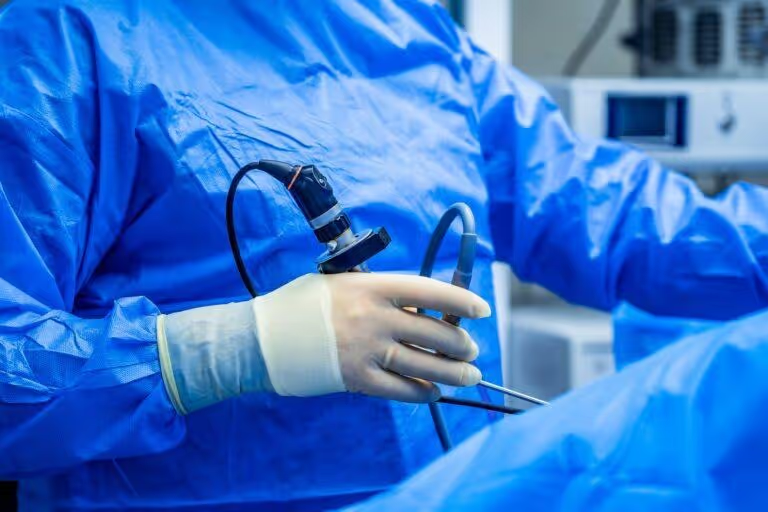
What Are Minimally Invasive Procedures?
Minimally invasive procedures use tiny incisions (often just 2–4 mm), catheters, guide wires, and imaging techniques like ultrasound, CT, or fluoroscopy to diagnose and treat medical conditions. They avoid large surgical cuts, minimizing trauma to the body.
Common examples include:
Why Seniors Benefit the Most
Older adults often have conditions like diabetes, hypertension, arthritis, or heart disease—making open surgery risky. Minimally invasive procedures provide a safer, gentler alternative.
1. Lower Risk Compared to Open Surgery
Smaller incisions mean:
This is particularly important for senior patients.
2. Faster Recovery Time
Most treatments allow:
This helps seniors return to daily life much sooner.
3. Less Pain, More Comfort
Because tissue damage is minimal, patients experience:
4. Suitable Even for Patients with Comorbidities
Seniors with:
…can safely undergo most minimally invasive vascular or joint procedures.
5. Excellent Precision through Imaging
Real-time imaging ensures high accuracy, reducing the chances of errors and complications.
Top Minimally Invasive Procedures Beneficial for seniors
✔ Arterial Embolization
Used for:
✔ Angioplasty & Stenting
Ideal for:
✔ Endovenous Laser Treatment (EVLT)
For varicose veins—done under local anaesthesia with quick recovery.
✔ PRP Therapy for Joint Pain
Helps regenerate tissue and reduce inflammation naturally.
✔ Image-Guided Joint Injections
For knee, shoulder, hip, and spine pain—precise and highly effective.
✔ Balloon Angioplasty
Useful for improving blood flow without major surgery.
Myths That Often Stop Seniors from Choosing MIP
❌ Myth 1: “Age is a barrier for any procedure.”
✔ Fact: Age alone is never the reason to deny treatment. What matters is overall fitness and condition.
❌ Myth 2: “Minimally invasive means less effective.”
✔ Fact: Many minimally invasive procedures match—and sometimes outperform—traditional surgery.
❌ Myth 3: “Recovery will still be slow.”
✔ Fact: Seniors often recover faster because there is less physical trauma and stress.
❌ Myth 4: “These treatments are painful.”
✔ Fact: Most procedures use local anaesthesia and are extremely comfortable.
How Minimally Invasive Procedures Improve Quality of Life
For many elderly individuals, these treatments feel like getting their life back.
Are seniors the Best Candidates? Absolutely.
Doctors now say:
“Don’t let age stop you—let your condition guide your decision.”
Minimally invasive treatments are specifically designed to be safe for:
Final Thoughts
Minimally invasive procedures are transforming elderly healthcare in India. They offer hope, comfort, safety, and dignity to seniors who previously had limited options. With quicker recovery, reduced risks, and excellent outcomes, these treatments truly break the age barrier.
Frequently Asked Questions (FAQ)
1. Are minimally invasive procedures safe for senior citizens above 70 or 80 years?
Yes. These procedures are extremely safe even for elderly patients with diabetes, hypertension, thyroid disorders, or heart issues. Age alone is never a barrier.
2. Will the procedure be painful?
Most minimally invasive procedures are performed under local anesthesia, ensuring minimal or no pain.
3. How long will recovery take?
Most seniors walk within hours and return home the same day or next day. Recovery is significantly faster compared to open surgery.
4. Do these procedures require general anesthesia?
No. Most minimally invasive treatments use only local anesthesia—ideal for heart and diabetic patients.
5. What is the hospital stay duration?
In 80–90% of cases, hospitalization is less than 24 hours.
6. Can seniors with multiple medical conditions undergo these procedures?
Yes. Patients with diabetes, BP, thyroid, mild cardiac issues, or obesity are good candidates.
7. Are the results long-lasting?
Yes. Most vascular and joint-based minimally invasive procedures offer long-term or permanent relief.
8. Will I need physiotherapy afterward?
Depending on the treatment, mild physiotherapy may be suggested, especially for joint-related procedures.
9. How soon can seniors resume daily activities?
Most can resume light activities within 24–48 hours.
10. Why choose Bankers Vascular Hospital for senior treatments?
Our hospital specializes in age-friendly, minimally invasive care with advanced machines, skilled doctors, and decades of expertise.
Conclusion
Senior citizens today no longer need to suffer or rely solely on painkillers. With advanced minimally invasive techniques, they can enjoy faster recovery, less pain, and a better quality of life—all without the risks of open surgery.
At Bankers Vascular Hospital, we’re committed to giving elderly patients a new chance at pain-free living.
Age is just a number—healing has no limit.


Comments
Post a Comment